Hello Explorers!
You all must be wondering after reading the title of it being a highly fictional topic and is only to be seen in some sci-fi movie stuff. But that is why I am here to guide you through the works of scientists who are successful in turning everyday fiction into reality.
LIGHT

First let us discuss about light and its properties as a brief introduction to the complexity of the topic.
So as we all know, Light is a form of energy present in the universe in the state of an Electromagnetic Radiation within a certain portion of the electromagnetic spectrum. It is the basic and the most extensive source of illumination to our world.
Some of its important properties are represented below -

- Light is formed of minute packet like structures known as photons.
- Light or an Electromagnetic wave (as called in physics) of visible spectrum has wavelengths in the range of 400-700 nm from infrared to ultraviolet.
- Light has a Dual nature (i.e. wave as well as particle nature).
- The speed of light is 3*10^8 in vacuum which is the maximum speed ever recorded denoted by 'c'.
Einstein's Theory
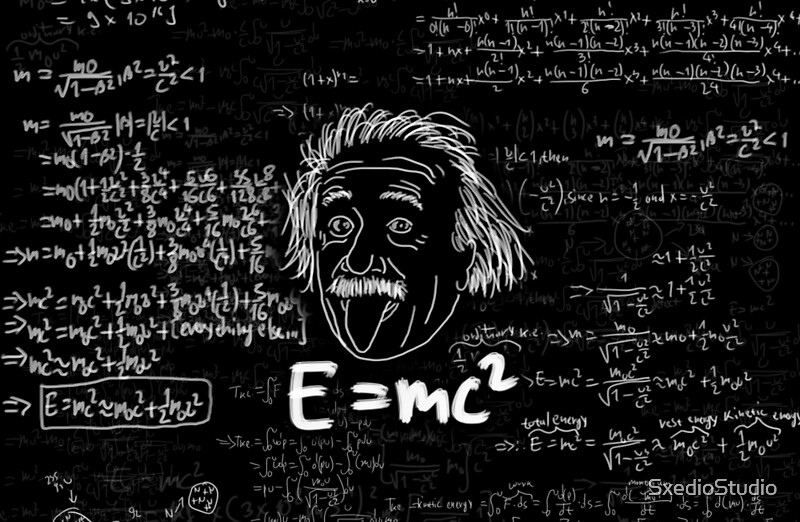
Albert Einstein, one amongst the greatest scientists in the human history has given an outstanding theory about light and a produced an equation on it. He was able to explain the his Special Theory of Relativity using this equation which was recently been experimented practically. The equation is-
E=mc^2
where E stands for Energy required or released, m represents the mass of the body and c is the speed of light in vacuum.
Here, he explains that if m is the mass then E would be the energy required for the mass to travel with the speed of light 'c'. In his theory he theorizes that a continuous amount of energy should be supplied to the mass for letting it travel at the speed of light.
But here are the
problems! -
1.
The mass of a body 'm'
increases with velocity as stated by Einstein in his theory of relativity* with
respect to momentum.
2.
He theorizes that a
continuous amount of energy should be supplied to the mass for letting it
travel at the velocity of light.
And combining the above
two problems, he has concluded that
"An infinite amount
of energy will be required for a body of mass m to move around an orbit with
the velocity of light and prevent itself from collapsing."
For many years
scientists had to accept the same conclusion as they were not able to prove anything
against it until 2011. Now lets come to the main topic.
TACHYON

In the year 1962, the possibility of particles moving faster than light was proposed by three Indians
In the year 1962, the possibility of particles moving faster than light was proposed by three Indians
O.M.P Bilaniuk, V.K.Deshpande
and E.C.G Sudarshan although the term they used for it was
"meta-particle".
In the 1967 paper that coined the term, Gerald Feinberg proposed that tachyonic
particles could be quanta of a quantum field with imaginary mass. However, it
was soon realized that excitation of such imaginary mass fields do not in fact
propagate faster than light, and instead represent an instability known as
tachyon condensation. Nevertheless, in modern physics the term "tachyon" often
refers to imaginary mass fields rather than to faster-than-light particles.
Such fields have come to play a significant role in modern physics.
On concluding these
possibilities of a faster-than light particle, they defined Tachyon as -
A Tachyon or Tachyonic
particle is a hypothetical particle that always moves faster
than light.
Most physicists believe
that faster-than-light particles cannot exist because they are
not consistent with the known laws of physics. If such particles did
exist, they could be used to build a tachyonic
antitelephone and send signals faster than light, which (according to
special relativity) would lead to violations of causality. Tachyons appear to violate causality (the so-called causality problem), since they could be sent to the past under the assumption that the principle of special relativity is a true law of nature, thus generating a real unavoidable time paradox. Therefore, it seems unavoidable that if tachyons exist, the principle of special relativity must be false, and there exists a unique time order for all observers in the universe independent of their state of motion.
Despite of theoretical
arguments against the existence of faster-than-light particles, experiments
have been conducted to search for them. No compelling evidence for their
existence were found until the year 2011.
NEUTRINOS
In September 2011, it was reported that a tau neutrino had traveled faster than the speed of light in a major release by CERN ; however, later updates from CERN on the OPERA project indicate that the faster-than-light readings were resultant from "a faulty element of the experiment's fibre optic timing system". But it could prove the possibility of the existence of a faster-than light particle so called as neutrino.
A neutrino is a subatomic particle that is very similar to an electron, but has no electrical charge and a very small mass, which might even be zero.
Neutrinos are one of the most abundant particles in the universe. Because they have very little interaction with matter, however, they are incredibly difficult to detect. Nuclear forces treat electrons and neutrinos identically; neither participate in the strong nuclear force, but both participate equally in the weak nuclear force. Particles with this property are termed leptons. In addition to the electron (and it's anti-particle, the positron), the charged leptons include the muon (with a mass 200 times greater than that of the electron), the tau (with mass 3,500 times greater than that of the electron) and their anti-particles.
Both the muon and the tau, like the electron, have accompanying neutrinos, which are called the muon-neutrino and tau-neutrino. The three neutrino types appear to be distinct: For instance, when muon-neutrinos interact with a target, they will always produce muons, and never taus or electrons.
Weak interactions create neutrinos in one of three leptonic flavors: electron neutrinos (νe), muon neutrinos (νμ), and tau neutrinos (ντ), in association with the corresponding charged lepton. Although neutrinos were long believed to be massless, it is now known that there are three discrete neutrino masses with different tiny values, but they do not correspond uniquely to the three flavors. A neutrino created with a specific flavor is in an associated specific quantum superposition of all three mass states. Although only differences of squares of the three mass values are known as of 2016, cosmological observations imply that the sum of the three masses must be less than one millionth that of the electron.

To detect neutrinos, very large and very sensitive detectors are required. Typically, a low-energy neutrino will travel through many light-years of normal matter before interacting with anything. Consequently, all terrestrial neutrino experiments rely on measuring the tiny fraction of neutrinos that interact in reasonably sized detectors. For example, in the Sudbury Neutrino Observatory, a 1000 ton heavy water solar-neutrino detector picks up about 1012 neutrinos each second. About 30 neutrinos per day are detected.(See the Diagrams Below)
Wolfgang Pauli first postulated the existence of the neutrino in 1930. At that time, a problem arose because it seemed that both energy and angular momentum were not conserved in beta-decay. But Pauli pointed out that if a non-interacting, neutral particle--a neutrino--were emitted, one could recover the conservation laws.
Neutrinos can be created in several ways, including in beta decay of atomic nuclei or hadrons, nuclear reactions such as those that take place in the core of a star, and supernova, and when accelerated particle beams or cosmic rays hit atoms. The majority of neutrinos in the vicinity of the Earth are from nuclear reactions in the Sun. In the vicinity of the Earth, about 65 billion (6.5×10¹⁰) solar neutrinos per second pass through every square centimeter perpendicular to the direction of the Sun.
Neutrinos can be created artificially with nuclear reactors and particle accelerators.
 Image: SUDBURY NEUTRINO OBSERVATORY

In September 2011, it was reported that a tau neutrino had traveled faster than the speed of light in a major release by CERN ; however, later updates from CERN on the OPERA project indicate that the faster-than-light readings were resultant from "a faulty element of the experiment's fibre optic timing system". But it could prove the possibility of the existence of a faster-than light particle so called as neutrino.
A neutrino is a subatomic particle that is very similar to an electron, but has no electrical charge and a very small mass, which might even be zero.
Neutrinos are one of the most abundant particles in the universe. Because they have very little interaction with matter, however, they are incredibly difficult to detect. Nuclear forces treat electrons and neutrinos identically; neither participate in the strong nuclear force, but both participate equally in the weak nuclear force. Particles with this property are termed leptons. In addition to the electron (and it's anti-particle, the positron), the charged leptons include the muon (with a mass 200 times greater than that of the electron), the tau (with mass 3,500 times greater than that of the electron) and their anti-particles.
Both the muon and the tau, like the electron, have accompanying neutrinos, which are called the muon-neutrino and tau-neutrino. The three neutrino types appear to be distinct: For instance, when muon-neutrinos interact with a target, they will always produce muons, and never taus or electrons.
Weak interactions create neutrinos in one of three leptonic flavors: electron neutrinos (νe), muon neutrinos (νμ), and tau neutrinos (ντ), in association with the corresponding charged lepton. Although neutrinos were long believed to be massless, it is now known that there are three discrete neutrino masses with different tiny values, but they do not correspond uniquely to the three flavors. A neutrino created with a specific flavor is in an associated specific quantum superposition of all three mass states. Although only differences of squares of the three mass values are known as of 2016, cosmological observations imply that the sum of the three masses must be less than one millionth that of the electron.
Detection of Neutrinos
To detect neutrinos, very large and very sensitive detectors are required. Typically, a low-energy neutrino will travel through many light-years of normal matter before interacting with anything. Consequently, all terrestrial neutrino experiments rely on measuring the tiny fraction of neutrinos that interact in reasonably sized detectors. For example, in the Sudbury Neutrino Observatory, a 1000 ton heavy water solar-neutrino detector picks up about 1012 neutrinos each second. About 30 neutrinos per day are detected.(See the Diagrams Below)
Wolfgang Pauli first postulated the existence of the neutrino in 1930. At that time, a problem arose because it seemed that both energy and angular momentum were not conserved in beta-decay. But Pauli pointed out that if a non-interacting, neutral particle--a neutrino--were emitted, one could recover the conservation laws.
Neutrinos can be created in several ways, including in beta decay of atomic nuclei or hadrons, nuclear reactions such as those that take place in the core of a star, and supernova, and when accelerated particle beams or cosmic rays hit atoms. The majority of neutrinos in the vicinity of the Earth are from nuclear reactions in the Sun. In the vicinity of the Earth, about 65 billion (6.5×10¹⁰) solar neutrinos per second pass through every square centimeter perpendicular to the direction of the Sun.
Neutrinos can be created artificially with nuclear reactors and particle accelerators.
Image: SUDBURY NEUTRINO OBSERVATORY
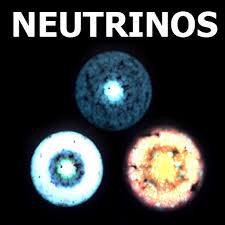
NEUTRINO TRAILS: When a neutrino hits the heavy water in the detector's spherical vessel, a cone of light--here clearly visible in red--spreads out to sensors surrounding the device. The neutrinos detected in this event are probably muon-neutrinos, produced when cosmic rays strike the earth's atmosphere.
Image: SUDBURY NEUTRINO
OBSERVATORY
FAINT EVIDENCE: In this
solar neutrino event, 75 of the 9,600 light sensors in the detector observed a
photon of light. Lines trace the path from the neutrino's impact with heavy
water to the light sensors.

CHERENKOV RADIATION
Cherenkov Light is another example of a Faster-than light particle.
Cherenkov radiation, light produced by charged particles when they pass through an optically transparent medium at speeds greater than the speed of light in that medium. Devices sensitive to this particular form of radiation, called Cherenkov detectors, have been used extensively to detect the presence of charged subatomic particles moving at high velocities.
Cherenkov radiation, also known as Vavilov–Cherenkov radiation, is an electromagnetic radiation emitted when a charged particle (such as an electron) passes through a dielectric medium at a speed greater than the phase velocity of light in that medium. The characteristic blue glow of an underwater nuclear reactor is due to Cherenkov radiation.
Physical Origin
While electrodynamics holds that the speed of light in a vacuum is a universal constant(c), the speed at which light propagates in a material may be significantly less than c. For example, the speed of the propagation of light in water is only 0.75c . Matter can be accelerated beyond this speed (although still to less than c) during nuclear reactions and in particle accelerators. Cherenkov radiation results when a charged particle, most commonly an electron, travels through a dielectric (electrically polarizable) medium with a speed greater than that at which light propagates in the same medium.
Practical Examples

Cherenkov radiation emitted by the core of the Reed Research Reactor located at Reed College in United States Nuclear Regulatory Commission
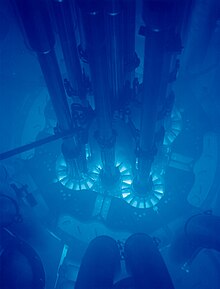
Cherenkov radiation glowing in the core of the Advanced Test Reactor.

The geometry of the Cherenkov radiation(shown for the ideal case of no dispersion)
Animation of Cherenkov radiation

CONCLUSION
Through this blog I hope that I am successful in exploring the main elements of our first topic i.e. Faster-than light. Scientists at NASA are trying to explore more about the existence of such particles by conducting various experiments like the LHC at CERN, particle accelerators all over, and the Neutrino Chambers. I am sure that they would surely be able to prove the existence of such particles in the coming future. The existence of such faster-than light objects could be the means of creating numerous possibilities like time travel in the future.
(* - I will be covering topics indicated by this symbol in my next blog)
Thank You!
(* - I will be covering topics indicated by this symbol in my next blog)
Thank You!
